Category Archives: 3D

Walkaround Weekend II: Electric Boogaloo

New Pinzgauer walkarounds are up!

Look, Ma, no more backwards text:

Updated interior:

Apparently, while my head was buried in Photoshop for the past couple weeks, I completely missed the fact that Unity 3.5 had been released several days ago. (The older walkarounds were done in the previous version of Unity.)

3.5 had some nifty changes that I wanted to try out this weekend, and I also wanted to update the walkaround model to reflect all of the texturing changes as well as the fact that both sides are now separately textured. So, this is kind of a combination Workbench and fun weekend post. :D

Get ‘em here:

Windows (32 bit)

Windows (64 bit)

Mac OS X Intel

The Percheron and Crotale are gone temporarily–I rebuilt the scene from scratch in Unity 3.5 to make use of some of the new features and to get around a wonky file import that took a while to figure out. I think I’ve figured things out, but this is also another compatibility check. Let me know if it works for you, and next weekend’s walkarounds should be a bit more populated.

Anyway, same drill as before–they’re zipped up, so extract the contents and double click on the executable.

3D walkaround test

I whipped up a 360 degree panorama of the Pinzgauer’s cargo bay the other day, and some of you folks said that you wanted to be able to walk around the Pinzgauer for real. Well, your wish is my command!

Those of you who have been around since the early days know I was into amateur videogame development in the early 2000s, and that was what eventually led me into developing papercraft models. I used to enjoy making little techdemos and stuff like that–being deaf, there’s no way I’m going to be able to swing a real game with sound and all that, but techdemos were safe territory for me because I didn’t need to worry about music, sound effects, or whatever.

It took me a couple of hours to get re-acquainted with Unity’s editor and tools today, and I put together a quick little walkaround project. Nothing fancy, just a simple first person walkthrough. You can download Windows and Mac versions below:

edited on 2-25-2012: links removed.

They’re all simple ZIP archives, no installers or anything. Extract them and click on the executable. Let me know if they work for you. In particular, I’m worried about the Mac versions working because I don’t own a Mac at all, so I can’t test them myself.

Also, as with the 360 degree panorama the other day, you will see reversed text on one side of the model. That will be fixed as soon as I actually start working on the other side’s textures. Also, the grass hill terrain thing is just a cheesy placeholder. :)

I’m really hoping that this works for everybody without any major issues, because I think it’d be a ton of fun to lay out a quick spaceport level the next time I take a weekend off, and then populate it with all of the supporter requests. You guys would then be able to walk around the spaceport and see all of the extras and accessories that you requested.

UPDATE: I’m uploading an updated version of the walkaround. The upload should be complete by 7:30AM CST.

New changes: improved the lighting significantly, got rid of the cheesy terrain and replaced it with Streets of Legend asphalt (a placeholder for the spaceport later), some other minor graphical tweaks, and the shuttle’s not alone on the tarmac anymore. :D

Okay, I’m about to go to bed. It’s Monday, which means I get back to work on the texturing and stuff when I get up this afternoon.

Bruce the Despoiler

Just for fun, I’m posting a couple shots of a non-canon scheme I did for the Despoiler a few months ago. In one of the Workbench posts for the Pinzgauer, TOPO commented that a countershaded blue-white scheme with a giant shark face would make it look like an angry whale, and that reminded me of Bruce the Despoiler:

(It’s not a paper model, it’s a realtime 3D model derived from the paper model.)

At that time, I needed a 3D model to test a Java 3D applet I came across on the Internet, I’d also been itching to try my hand at the kind of odd multi-tone camo style that USAF fighters are painted in, I’ve always liked shark teeth on planes, and the name of the mechanical shark in Jaws (and the one in Finding Nemo) was Bruce, Despoilers have very predatory behavioral patterns, and I basically just poured all of that stuff together into a blender and pushed the “Frappe” button.

Digital clay!

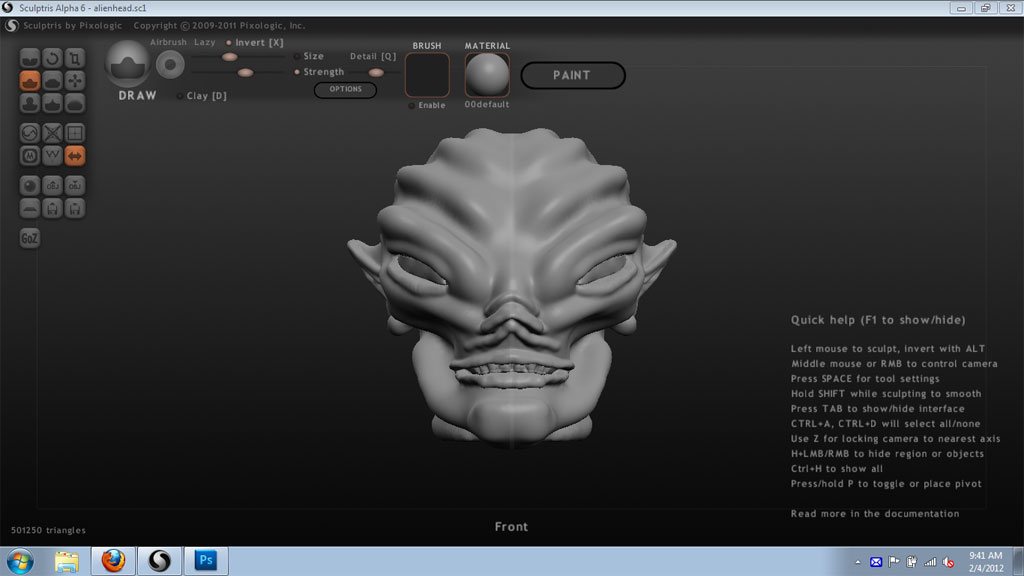
I found another fun new toy, Sculptris. I was looking for something simple to use for occasional character modeling, and weird organics are a lot easier to block out if you’re using a “sculpting with clay” sort of paradigm.

I ended up with this silly little alien head in about half an hour of semi-randomly messing around:

The toolset is pretty intuitive. I didn’t need to consult any documentation to get that far because the tool names and the way they work are pretty clear if you have any background in messing around with clay. Pinch, push, pull, smooth, crease. I like that.

At some point, I want to delve further into this program and try something a bit more ambitious than Mr. Lumpyhead up there. The thought of eventually being able to whip up whatever organic figure I wanted and send it off to be printed is kinda fun–I’d never have to bemoan the unavailability of some specific figure I wish I had again.

Now, if I had a time dilation machine, I could get in all the practice I wanted without impacting anything else like work, sleep, or social contact.

SketchUp

Every year, I go through a review of my software suite and processes to see if there’s anything I can do to improve or streamline things further. There wasn’t much this year in the way of new software to choose from (I’d already upgraded to Photoshop CS5 back in 2011), but I was intrigued by the fact that there were now 3 unfolding plugins for Google SketchUp, 2 of which are specifically oriented towards papercraft development. I thought I’d give the thing a try just to see if it was worth doing.

The first candidate was Waybe, which is a commercial plugin. It looked like a fairly decent start, but I nearly fell out of my chair laughing when I saw their commercial license pricing. It costs $200 per year for commercial use and only has a subset of the functionality that you get with something like Ultimate Papercraft 3D, which only costs $39.95. That put Waybe out of the running before the race even began.

Our next contender is Flattery, which is a simpler plugin. It’s free, but the author accepts donations, which is good because money’s a nice incentive to keep working on something. It does what it says on the tin, but it’s a long way from being in the same league as Ultimate Papercraft 3D or Pepakura Designer. It’s still got potential, though.

In the end, I decided that SketchUp still doesn’t cut the mustard as a papercraft development tool. I mean, you can use it for that, but it’s not quite something I’d consider suitable for a production environment.

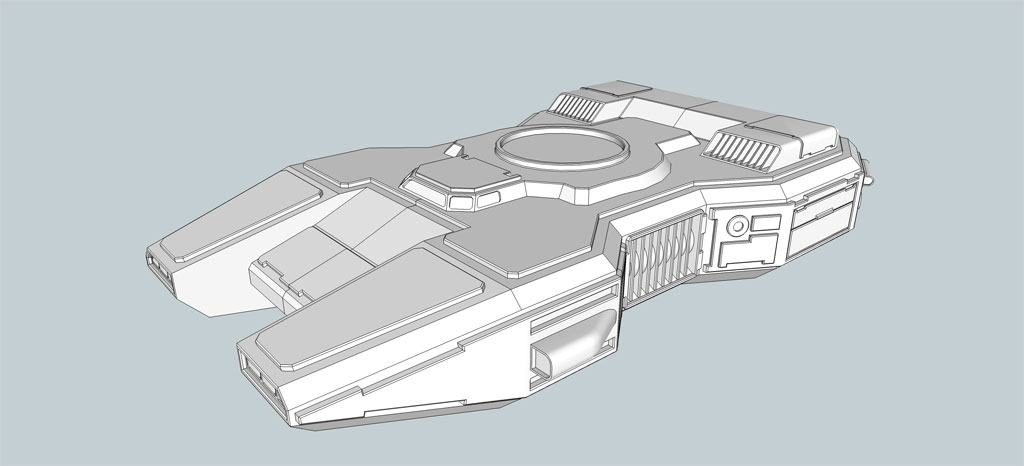
However…I did fall in love with it for another purpose entirely. It has a rather unconventional toolset that, once you get the hang of it, makes detailing and greebling models surprisingly easy. This is my second SketchUp model, some sort of half-assed floaty tank thing that’s really just meant to be a canvas for figuring out the best ways to greeble stuff:

Greeblewagen!

It’s kind of nuts–I never had it this easy back in the 1990s when I was doing photorealistic 3D modeling. That thing above only took me a few hours of goofing around in SketchUp to do, and would easily have required significantly more time in my other more conventional 3D modeling applications. I’m going to see if this thing can actually export nice, clean, and watertight solids that can be used for 3D printing. If it can do that, that’d be awesome.